“A strong portfolio, like a strong building, begins with a strong foundation.”
MGQIBetter Businesses. Stronger Portfolios. Longer Horizons.
The Framework
The Central Idea
Investing is often reduced to a single question: What should I buy?
But building a durable portfolio requires answering three different questions:
- What deserves to be owned?
- When does it deserve capital?
- How much capital should it receive?
These questions are related, but they are not the same.
The MGQI Framework separates them into three distinct layers—Fundamentals, Market Confirmation & Execution, and Portfolio Architecture—so that business quality, market behaviour and capital allocation can work together without being confused with one another.
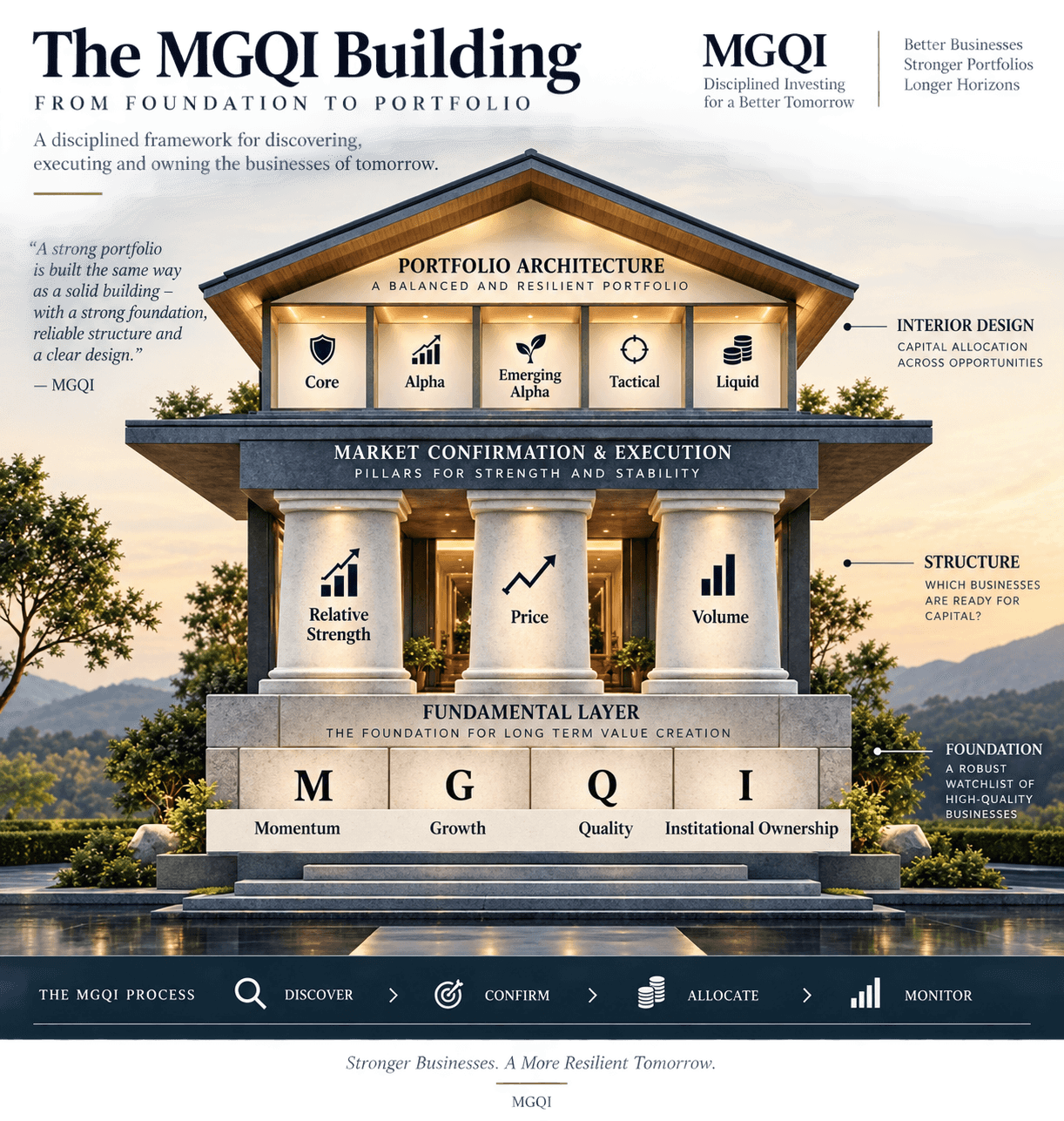
The MGQI Building — the framework at a glance
The Foundation identifies the businesses worth considering. The Structure evaluates whether market behaviour supports deployment of capital. The Interior Architecture determines how that capital should be distributed across the portfolio.
01 / Foundation
The Foundation — Fundamental Layer
Every durable building begins with its foundation. A foundation must support what is built above it, withstand stress and provide the basis for longevity.
The Fundamental Layer is the foundation of MGQI. Its purpose is to identify businesses robust enough to deserve further consideration—not necessarily to decide the exact moment of purchase.
M + G + Q + I
M, G, Q and I represent Momentum, Growth, Quality and Institutional Ownership. Here, Momentum refers specifically to earnings growth momentum—not technical momentum in price action. Together, they create a high-quality universe of businesses and a disciplined watchlist.
The important point is that the Fundamental Layer is not yet the portfolio. It is the pool from which portfolio candidates can emerge.
Core questionWhat deserves to be considered for ownership?
02 / Structure
The Pillars and Roof — Market Confirmation & Execution
A strong foundation alone does not make a building complete. The structure above it must also be sound.
In MGQI, this is the role of the Technical Layer. Three elements form the market-facing structure:
Relative StrengthMarket leadership and confirmation
PricePrice structure and execution
VolumeParticipation and conviction behind price movement
The technical layer sits on top of the fundamental foundation. It does not replace it. A strong chart cannot compensate for a fundamentally weak business. Instead, market behaviour is used to determine whether a fundamentally attractive business is showing the characteristics required for portfolio entry.
This is why MGQI refers to this layer as Market Confirmation & Execution. The Fundamental Layer identifies the opportunity. The Technical Layer asks whether the market is beginning to confirm that opportunity—and whether the current price structure supports deploying capital.
Core questionWhich businesses in the watchlist are ready for capital?
03 / Portfolio
Interior Architecture — Portfolio Architecture
Once the foundation and structure are in place, there is still one crucial question: How should the available capital be organised?
A building is not defined only by its foundation and structural strength. Its interior architecture determines how its available space is used. The same is true of a portfolio.
A portfolio is not simply a collection of stocks. It is an allocation of capital across opportunities with different levels of maturity, conviction and purpose.
COREEstablished, high-conviction long-term holdings
ALPHAEstablished opportunities with demonstrated strength and execution
EMERGING ALPHAPotential future leaders where conviction is still developing
TACTICALOpportunistic allocations with a more tactical purpose
LIQUIDCapital reserve providing flexibility and optionality
The important insight is that selection and allocation are different decisions.
A business can be attractive without deserving a large position. Likewise, a promising emerging opportunity may deserve a place in the portfolio without yet warranting Core-level allocation.
Portfolio Architecture translates conviction and role into capital allocation. And this architecture is not static. As evidence accumulates, a holding can evolve. Its role can change. Its allocation can change. The portfolio itself can change as opportunities, risks and market conditions change.
Core questionHow much capital should each opportunity receive?
The Architecture
The Three Layers Working Together
The strength of MGQI does not come from any individual component. It comes from the interaction between the three layers.
| MGQI layer | Building analogy | Core question |
|---|
| Fundamental Layer | Foundation | What deserves to be owned? |
| Technical Layer | Pillars & Roof | When does it deserve capital? |
| Portfolio Architecture | Interior Architecture | How much capital should it receive? |
The Process
The MGQI Construction Sequence
MGQI turns the three layers into a continuous decision process. Each stage answers a different question, and each stage builds on the evidence gathered before it.
01DISCOVERM · G · Q · IBuild the watchlist
02CONFIRMRS · PRICE · VOLUMEAssess market behaviour
03ALLOCATEPortfolio ArchitectureDetermine capital
04MONITORBusiness · Market · PortfolioReassess as evidence evolves
DISCOVER → CONFIRM → ALLOCATE → MONITOR
The Discipline
Why the Sequence Matters
The order matters because each decision depends on the one before it.
A technically strong stock may attract attention. But technical strength alone does not establish business quality.
A high-quality business may have an excellent long-term opportunity. But that does not necessarily mean capital should be deployed immediately or at maximum size.
And even when an investment qualifies for the portfolio, its appropriate allocation depends on its role, maturity and conviction relative to the rest of the portfolio.
MGQI therefore avoids the temptation to answer everything with a single signal.
The principleStrong foundation. Sound structure. Deliberate allocation.
The Complete MGQI Building
FOUNDATIONFundamental LayerM · G · Q · I
STRUCTUREMarket Confirmation & ExecutionRELATIVE STRENGTH · PRICE · VOLUME
INTERIOR ARCHITECTUREPortfolio ArchitectureCORE · ALPHA · EMERGING ALPHA · TACTICAL · LIQUID
The Complete Framework
The foundation determines whether the building has the strength to last. The structural framework determines whether it can stand securely. The interior architecture determines how the available space is organised and used.
In the same way, MGQI moves from business discovery to market confirmation to portfolio construction without treating those as the same decision.
The Philosophy
The Core Philosophy
The objective of MGQI is not simply to find stocks. It is to create a disciplined investment process through which the right businesses are discovered, market behaviour is evaluated, and capital is allocated according to conviction and portfolio role.
Because investing is not a single decision. It is a sequence of decisions made as evidence accumulates.
- What should I own?
- When should I act?
- How much should I commit?
- How should that position evolve?
- What evidence would make me change my mind?
That is the difference between identifying an investment and building a portfolio.
DISCOVER THE RIGHT BUSINESSES.
CONFIRM WITH THE MARKET.
ALLOCATE WITH CONVICTION.
MONITOR AS THE EVIDENCE EVOLVES.
MGQINOTE This article presents the conceptual architecture of the MGQI framework. Individual components—including the fundamental dimensions, Relative Strength, technical confirmation, portfolio layers and specific investment applications—can be explored in greater depth through dedicated MGQI research articles and case studies.